Draper City's 2022 water quality report shows total hardness from 16 to 357 mg/L, using 2021 data. On the USGS scale, 357 mg/L counts as very hard, while 16 mg/L is soft. That spread means your water depends on which source feeds your street. If scale, spotting or a short-lived water heater are bothering you, call (385) 488-1892 and we can test water at your tap.
Hardness in plain terms
| Hardness (mg/L as calcium carbonate) | Description | What you notice |
|---|---|---|
| 0 to 60 | Soft | Soap lathers easily, little scale |
| 61 to 120 | Moderately hard | Occasional spots on glass |
| 121 to 180 | Hard | Visible scale on fixtures and in kettles |
| Over 180 | Very hard | Heavy scale, shorter heater life, stiff laundry |
Hardness is mostly dissolved calcium and magnesium. They are not a health risk. They are a plumbing and cleaning problem, because minerals precipitate when water heats and leave a hard crust.
Which utility serves you?
Draper has two culinary water providers. The Utah Division of Water Resources describes Draper City service as generally west of I-15 and south of 14600 S, and WaterPro culinary service as generally east of I-15 and north of 14600 S.
The name on your water bill is the surest way to know. Draper City buys its water wholesale from Jordan Valley Water Conservancy District. We do not have a verified hardness figure for WaterPro customers, so ask them directly for current numbers.
Draper note: total dissolved solids and quality reports
Draper City's report lists total dissolved solids from not detected to 652 ppm, again depending on the source. Higher dissolved solids often travel with higher hardness. Utilities are required to publish an annual water quality report, so you can ask your provider for the latest edition rather than relying on a 2021 figure.
The city also states that its supply area has no lead service lines. That is a separate question from hardness. Old household plumbing inside the house can still contain other materials, and a plumber can identify them when pipes are exposed.
Signs hard water is hitting your home
White crust on fixtures
Scale builds on faucets, shower heads and around drains.
Spotted dishes and glass
Minerals dry on surfaces and leave marks.
Low flow from aerators
Scale narrows openings and reduces flow.
Water heater problems
Sediment and scale shorten tank and element life. See water heater repair.
Soap that will not lather
You use more soap, and laundry feels stiff.
Options, from simple to complete
Test first
Measure hardness at your tap. A test strip gives a rough idea, and a lab or a plumber test gives a better one.
Maintain what you have
Flush your water heater yearly, clean aerators with vinegar and descale a tankless unit on schedule.
Choose a treatment
A salt-based softener removes calcium and magnesium. A conditioner changes how scale forms but does not remove the minerals.
Plan the install
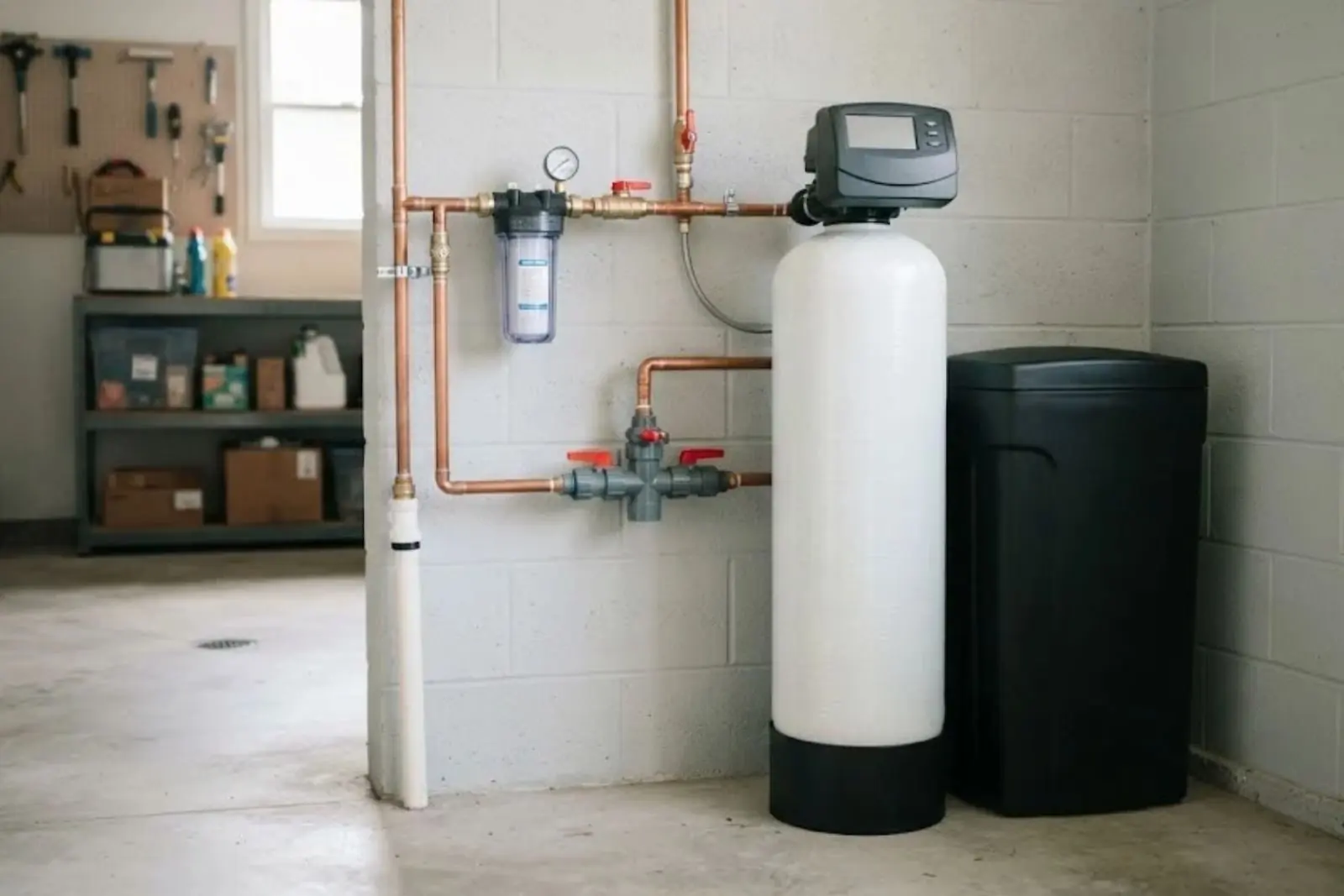
The unit goes on the main water line with a bypass, a drain connection and a power outlet.
A softener helps with
- Scale in heaters and pipes
- Spots on glass and fixtures
- Soap performance and laundry
- Fixture and appliance wear
Think twice when
- Your water is already soft where you live
- You cannot connect to a drain
- Brine discharge is restricted where you live
- A sodium-restricted diet applies to drinking water
For the full process, see water softener installation. If your problem is mostly the heater, replacement with a softener upstream protects the new unit.
Scale and spotting?
Call to book a hardness test and a straight answer on whether a softener fits.
A simple test you can do tonight
Fill a clear bottle one-third full of tap water, add a few drops of pure liquid soap, cap it and shake for ten seconds. Thick suds with clear water suggest softer water. Few suds and cloudy water suggest harder water. It is not a lab test, but it tells you whether to ask for a real measurement.
For a proper reading, test strips from a hardware store give a rough number, and a plumber visit gives a tap-level measurement. Compare it to the report from your utility. If the two are far apart, tell us, because your home plumbing may be contributing something the utility test missed.
What hard water costs you over time
Scale is a gradual tax. A heater that works harder to heat through a layer of scale uses more energy. Aerators clog, shower heads lose spray and cartridges in faucets stick. None of this is dramatic, which is why hard water often goes unaddressed until a heater fails earlier than it should. The cheapest time to act is before the first failure.
If your house has a mix of old and new plumbing
Older fixtures with brass or galvanized parts collect scale in tight passages first. If you notice clogged shower heads in one bathroom but not another, the difference may be pipe age and routing, not water quality. A plumber can compare lines and tell you whether a whole-house fix or a single fixture swap solves it.
Ask the local authorities
Salt discharge rules vary. South Valley Sewer District, at (801) 571-1166, serves Draper and nearby cities and can answer questions about brine discharge. For permits, ask the Draper Building Division at (801) 576-6399.
A note on outdoor water
Draper's water element reports that about 63% of demand is outdoor use. Much of that is secondary irrigation water, which is not softened and not treated for drinking. Do not connect a softener to your irrigation line. Keep it on the culinary water entering the house.
What to do before you buy treatment equipment
- Read your latest water quality report from the utility named on your bill.
- Test hardness at your own tap instead of relying on a citywide figure.
- Ask a doctor about sodium if anyone in the home follows a restricted diet.
- Keep the softener on the culinary line only, not on irrigation.
- Ask your sewer provider whether brine discharge has any limits.
Sources and standards behind this page
According to Draper City's 2022 water quality report, total hardness ran 16 to 357 mg/L and total dissolved solids ran from not detected to 652 ppm, based on 2021 data. Hardness categories follow the USGS scale, and service boundaries come from the Utah Division of Water Resources.
Straight Answers
It can be. Draper City reports total hardness from 16 to 357 mg/L depending on source, and the upper end counts as very hard on the USGS scale.
Check your water bill. The Utah Division of Water Resources describes Draper City service as generally west of I-15 and south of 14600 S and WaterPro service as east of I-15 and north of 14600 S.
Hardness minerals are not generally a health concern. They cause scale and cleaning problems. Ask your utility for its latest water quality report.
Usually it reduces them a lot. Dishwasher rinse aid helps too.
No. Install a softener only on the culinary line that enters the house.
Yes. Call (385) 488-1892 to book a visit. We measure hardness at your tap and tell you honestly whether a softener makes sense.