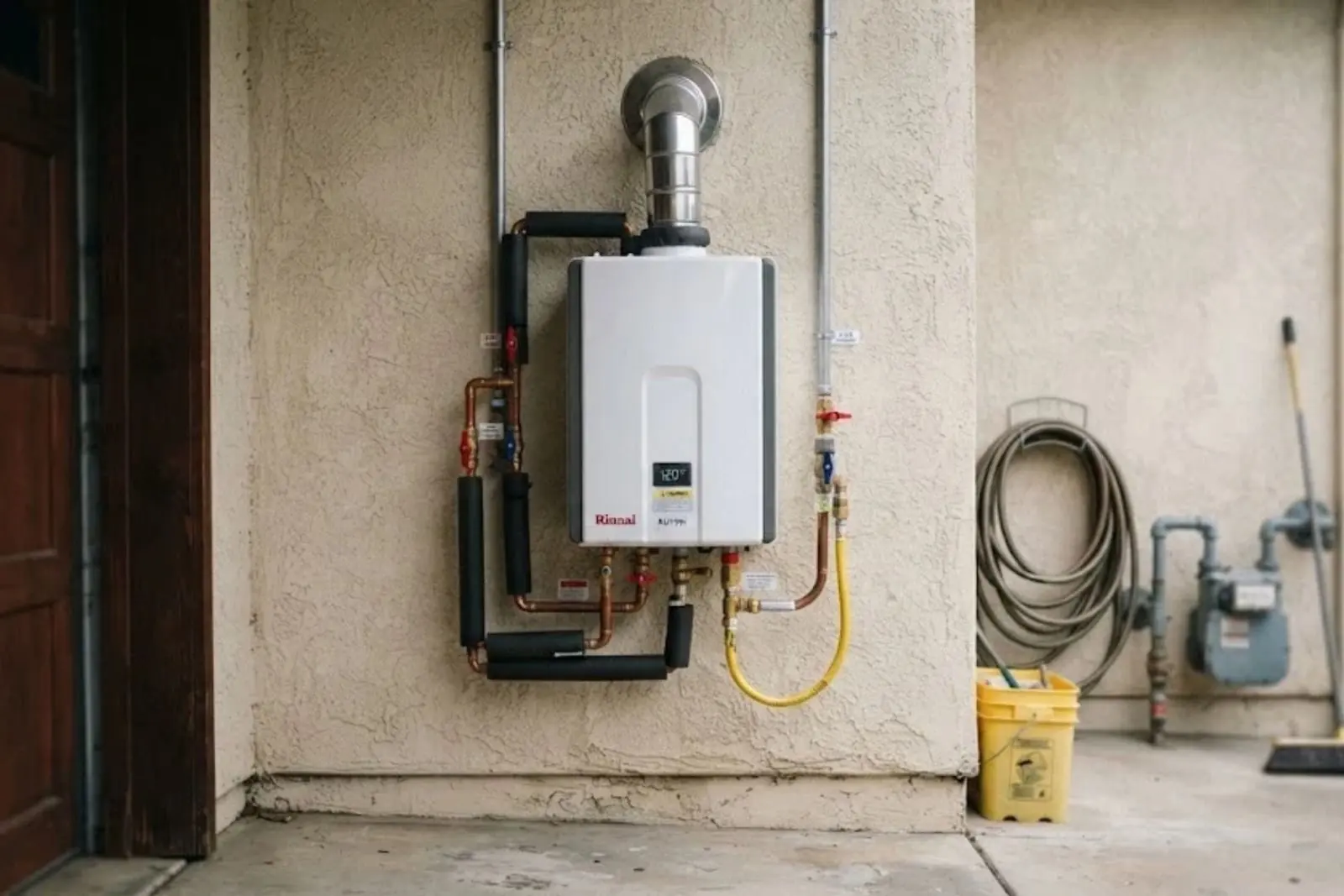
A tank heater is the lower-cost, simpler choice and fits most homes. A tankless heater suits households that want hot water on demand and have a gas line, venting and a water supply that support it. If you want help deciding, call (385) 488-1892 and we will look at your house, your fuel and your hot water habits before recommending anything.
Side by side
| Factor | Tank | Tankless |
|---|---|---|
| Upfront cost | Lower | Higher |
| Hot water supply | Limited by tank size, recovers slowly when empty | Continuous up to the unit flow limit |
| Space | Floor space for a tank and pan | Wall mounted, smaller footprint |
| Typical life | Roughly eight to twelve years | Often longer with maintenance |
| Maintenance | Flush yearly, check the anode | Descale yearly, especially in hard water |
| Installation | Straightforward swap | May need larger gas line, new vent or power |
| If it fails | Tank may leak | Part failure, rarely a flood |
Questions that decide it
How many people use hot water at once?
Count showers, dishwasher and laundry running together.
What fuel do you have?
Natural gas, propane or electric. Tankless gas units need enough gas flow.
Where would the heater go?
A garage corner is easy. A finished closet needs venting and clearance.
How long will you stay?
A higher upfront cost pays back over years, not months.
How hard is your water?
Scale shortens both types of heater, and tankless heat exchangers are less forgiving.
Draper note: cold inlet water and hard water
Draper sits near 4,751 feet with snow from November to March, so incoming water is cold in winter. A tankless unit has a maximum temperature rise, so when the inlet drops, maximum flow drops with it. A unit that serves two showers in July may serve one in January. Size for the winter number.
Draper City's water quality report lists total hardness up to 357 mg/L at some sources. A tankless heat exchanger scales and loses efficiency if it is not flushed. A softener upstream protects either type of heater. Check your bill to see which utility serves you and ask them for current hardness data.
Where tank heaters win
Simple swaps
Replacing like with like is quick and keeps the existing gas and vent.
Lower purchase price
Good for tight budgets or short-term ownership.
Large households with stable use
A big tank handles a morning rush without special gas or vent changes.
Easy service
More plumbers are familiar with tank maintenance.
Where tankless wins
No standby loss
There is no tank of hot water sitting idle.
Space
Wall mounting frees floor area.
No tank to leak
A failure usually means a part, not a flood.
Steady supply
Hot water keeps coming until the unit hits its flow limit.
Read more on tankless water heaters, planned installation and emergency replacement. If your current tank is failing and you cannot decide, a tank swap gets you hot water now, and you can plan a tankless upgrade later.
A realistic look at cost over time
Tankless units cost more up front, and the savings come from lower standby loss and a longer life. Whether you reach the break-even point depends on how long you stay, how much hot water you use and what your fuel costs.
A household of two that travels often may not recover the extra cost. A busy family that stays in the house for fifteen years often does. Ask for numbers using your own use, not generic averages.
Do not forget installation costs that are not in the price of the unit. A larger gas line, a new vent and an electrical outlet can add meaningfully to the total. Ask for them in writing so you compare complete prices.
Choosing a heater?
Call and we will size both options for your house.
What about running out of hot water?
A tank runs out because it is a fixed volume. A tankless unit runs out of capacity because it has a flow limit. The symptoms look similar: the shower goes cold when someone starts the dishwasher. The cure differs. For a tank, a larger tank or a staggered schedule helps. For tankless, a larger unit, a second unit or reduced simultaneous use helps.
Recirculation matters too. If a fixture is far from the heater, you wait for hot water to arrive, and a recirculation pump can shorten the wait. Ask about it during design, since adding it later is harder.
Sizing by real habits
Ask yourself when the heaviest hot water use happens. A household where two people shower at the same time every morning behaves very differently from a household that spreads showers across the day. Tank size or tankless flow rating should match the peak, not the average.
Write down the worst ten minutes of a typical week, and share that with whoever gives you a recommendation. It is the single most useful piece of information for sizing either type of heater.
Also count fixtures. A large soaking tub can empty a standard tank in one fill, while a rain shower head can exceed the flow of a small tankless unit. These are not reasons to avoid either type. They are reasons to choose the right capacity the first time.
Utah code and permits
Utah amends the model plumbing code. A tank heater must be anchored or strapped, and the pan drain must be trapped and vented where a pan is required. Gas appliances need correct venting and clearances. Ask the Draper Building Division at (801) 576-6399 whether your project needs a permit, and verify your plumber on the state licensing lookup.
Maintenance either way
Keep either type healthy
- Flush a tank yearly, descale a tankless unit on schedule.
- Test the relief valve on a tank heater.
- Keep the area around the heater clear.
- Watch for moisture, rust or unusual noises.
- Consider a softener if your water is very hard.
Sources and standards behind this page
Tank anchoring and pan drain rules come from the Utah amendments to the International Plumbing Code (IPC) as amended by the Utah State Construction Code in Utah Code Title 15A. Tankless venting and gas sizing follow the International Plumbing Code (IPC) as amended by the Utah State Construction Code in Utah Code Title 15A and the manufacturer's instructions. Hardness figures come from Draper City's 2022 water quality report.
Straight Answers
Neither is better for everyone. Tankless offers on-demand hot water and saves space, while tank heaters cost less and are simpler to install.
Yes, but cold incoming water reduces maximum flow, so the unit must be sized for winter conditions.
Often. A gas tankless unit burns a lot of fuel at once, so the gas pipe and meter capacity matter.
Often longer than a tank with maintenance, but it needs regular descaling, especially with hard water.
Yes. Scale builds on the heat exchanger. Flush yearly and consider a softener.
We can often handle emergency replacements the same day. Call (385) 488-1892 any hour.